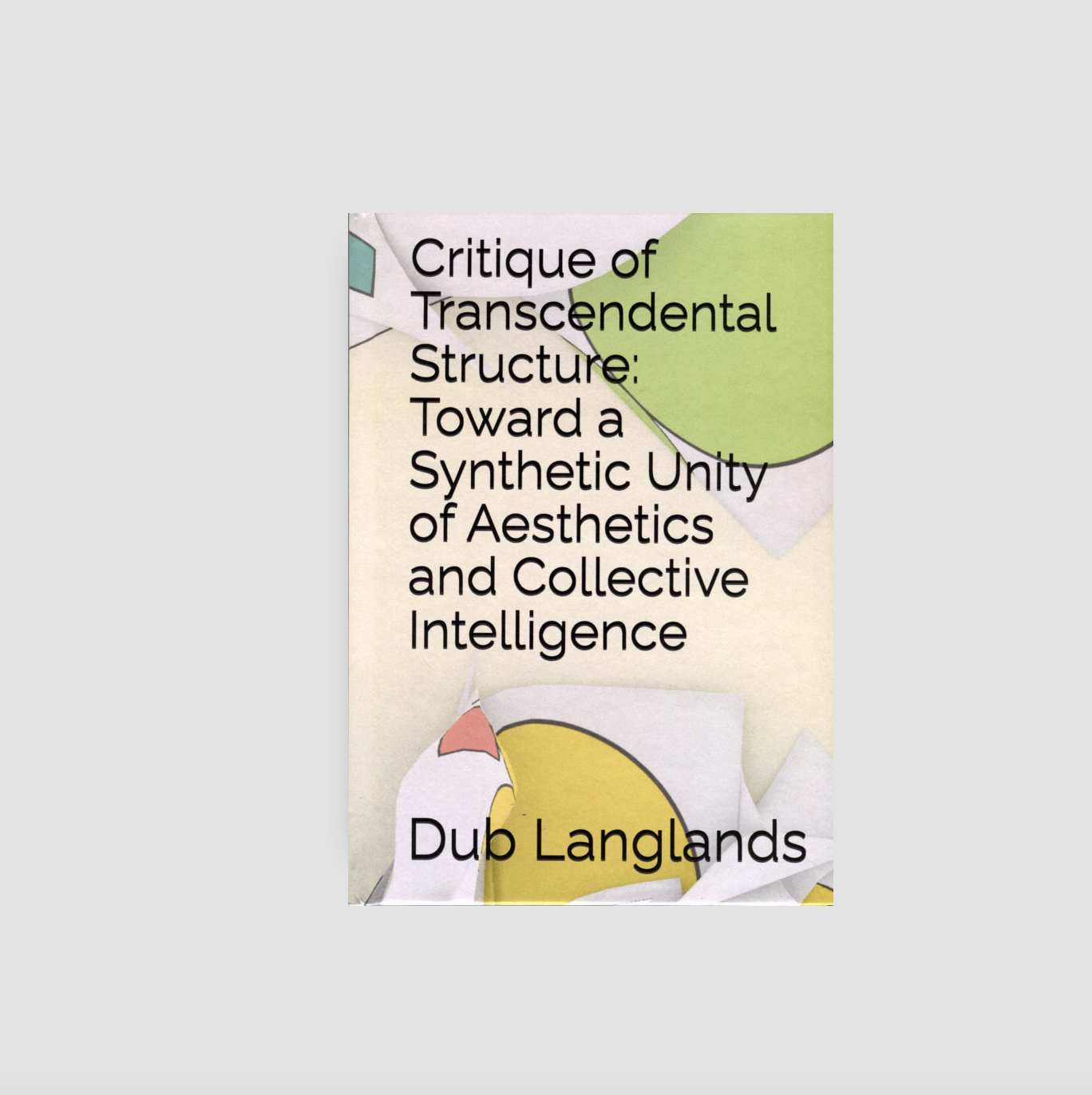
Critique of Transcendental Structure: Toward a Synthetic Unity of Aesthetics and Collective Intelligence
From backside of the book:
This groundbreaking interdisciplinary work unites mathematics, philosophy,aesthetics, and computer science into a visionary framework for understanding how meaning emerges across systems. From the precise formalism of sheaf theory to the creative dynamics of artistic production, this magnum opus reveals the profound connections between local phenomena and global structures that underpin both human creativity and collective intelligence.
The work opens with rigorous mathematical foundations in sheaf theory and cohomology, establishing a language for how local information combines into coherent wholes. This formalism is then brilliantly applied to multi-agent systems, drawing significantly on the pioneering work of Hans Riess on lattice-theoretic approaches to multi-agent systems. The author builds upon the seminal contributions of Hanks, Riess, Fairbanks, and Hale et al, whose research on distributed multi-agent coordination over cellular sheaves introduced the groundbreaking concept of the nonlinear sheaf Laplacian and nonlinear homological programs-a powerful tool for unifying diverse coordination tio tasks under a single optimization framework.
The text elaborates on how these researchers innovative application of sheaf-theoretic principles to coordination problems provides a mathematically rigorous foundation for understanding decentralized systems. By extending the frameworks developed by Fairbanks, Hale, and their collaborators, the author developsaproposal for sheaf-theoretic models for economic and learning systems that reveal previously hidden structural relationships.
Moving beyond technical applications, the text transforms into a profound philosophical and artistic manifesto.
It reframes artistic creation as a process of sheafification-the careful assembly of local components into a unified whole that transcends the sum of its parts. Through concrete examples from curatorial practice and sound art, the author demonstrates how these mathematical principles illuminate the creative process itself.
The work culminates in a philosophical synthesis that challenges traditional epistemological boundaries, proposing a non-dualistic framework where knowledge emerges not from isolated perspectives but through the systematic integration of diverse viewpoints. In doing so, it offers nothing less than a new conceptual foundation for understanding complexity across domains-a transcendental structure for our fragmented age that finds unity without sacrificing difference.
From backside of the book:
This groundbreaking interdisciplinary work unites mathematics, philosophy,aesthetics, and computer science into a visionary framework for understanding how meaning emerges across systems. From the precise formalism of sheaf theory to the creative dynamics of artistic production, this magnum opus reveals the profound connections between local phenomena and global structures that underpin both human creativity and collective intelligence.
The work opens with rigorous mathematical foundations in sheaf theory and cohomology, establishing a language for how local information combines into coherent wholes. This formalism is then brilliantly applied to multi-agent systems, drawing significantly on the pioneering work of Hans Riess on lattice-theoretic approaches to multi-agent systems. The author builds upon the seminal contributions of Hanks, Riess, Fairbanks, and Hale et al, whose research on distributed multi-agent coordination over cellular sheaves introduced the groundbreaking concept of the nonlinear sheaf Laplacian and nonlinear homological programs-a powerful tool for unifying diverse coordination tio tasks under a single optimization framework.
The text elaborates on how these researchers innovative application of sheaf-theoretic principles to coordination problems provides a mathematically rigorous foundation for understanding decentralized systems. By extending the frameworks developed by Fairbanks, Hale, and their collaborators, the author developsaproposal for sheaf-theoretic models for economic and learning systems that reveal previously hidden structural relationships.
Moving beyond technical applications, the text transforms into a profound philosophical and artistic manifesto.
It reframes artistic creation as a process of sheafification-the careful assembly of local components into a unified whole that transcends the sum of its parts. Through concrete examples from curatorial practice and sound art, the author demonstrates how these mathematical principles illuminate the creative process itself.
The work culminates in a philosophical synthesis that challenges traditional epistemological boundaries, proposing a non-dualistic framework where knowledge emerges not from isolated perspectives but through the systematic integration of diverse viewpoints. In doing so, it offers nothing less than a new conceptual foundation for understanding complexity across domains-a transcendental structure for our fragmented age that finds unity without sacrificing difference.
Critique of Transcendental Structure: Toward a Synthetic Unity of Aesthetics and Collective Intelligence
Published by:
Santolarosa / Centralbanken
Year:
2025
ISBN: 9798281492751
175 NOK
︎︎︎Add to cart